How to Size an Instrument Air Package for an Oil & Gas Production Site
An instrument air package has to do more than make compressed air. At an oil and gas production site, it must supply clean, dry air at adequate pressure to the pneumatic devices that keep the process operating. If the package is undersized, valves may move slowly, controls may become unstable, and the compressor may cycle excessively. If it is poorly matched to the site, moisture, pressure loss, or inadequate storage can create reliability problems even when the compressor horsepower looks sufficient.
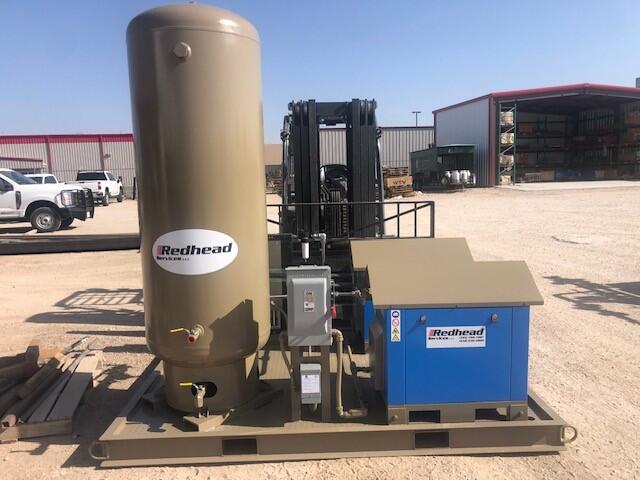
Redhead Services designs and fabricates configurable instrument air packages for production facilities. Available packages can include reciprocating or screw air compressors, a desiccant air dryer, a vertical air receiver, and a steel skid supporting the compressor and dryer. The right configuration depends on the actual air users, operating pressure, site conditions, and the consequences of losing air.
This guide explains the information needed to evaluate a package. It is not a substitute for a final application review using verified device and site data.
Start With the Equipment That Will Use Air
Sizing begins with an inventory of every connected air user. On the production facilities Redhead serves, those users may include vessel control valves, dump valves, pumps, and other pneumatic controls. Record the manufacturer and model when possible because consumption can vary significantly between devices that appear similar.
For each device, gather:
- Required supply pressure
- Normal air consumption
- Air used during a full stroke or operating cycle
- How often it operates
- Whether several devices can operate at the same time
- Its required action if instrument air pressure is lost
Do not size the package from device count alone. A modulating control valve, an intermittently cycling dump valve, and a pneumatic pump can place very different demands on the system.
Separate Normal Demand From Peak Demand
Normal demand determines how much air the package must produce over time. Peak demand determines whether header pressure remains stable when several devices operate together. Both conditions matter.
Add the continuous consumption of the connected instruments, then evaluate credible simultaneous events. A vessel upset, startup sequence, shutdown, or group of cycling dump valves may create a short demand that is much higher than the average. The air receiver can help cover brief peaks, but it cannot compensate indefinitely for a compressor that is too small for the sustained load.
Include a reasonable allowance for distribution leakage and future users, but do not replace actual device information with a broad safety factor. Excessive oversizing can cause short cycling on reciprocating compressors or inefficient operation at low load.
Confirm Pressure at the Farthest Device
The package discharge pressure is not necessarily the pressure available at the most remote valve. Filters, dryers, regulators, undersized piping, long tubing runs, fittings, and simultaneous flow all create pressure loss.
Establish the minimum pressure required by the most demanding device and work backward through the distribution system. The compressor control range and receiver pressure must provide enough margin for expected losses without exceeding the ratings of downstream equipment.
A pressure problem at one device does not automatically mean the compressor is too small. A restricted filter, wet line, closed valve, failed regulator, or undersized branch can produce the same symptom. Package sizing and distribution design should be reviewed together.
Select the Compressor Around Duty, Not Preference
Redhead instrument air packages can be configured with reciprocating or screw air compressors. Neither type is automatically correct for every facility.
- Reciprocating compressors can suit smaller or intermittent loads and offer straightforward maintenance.
- Screw compressors can suit steady or continuous air demand and provide smooth delivery.
The choice should reflect required flow and pressure, operating hours, load profile, available power, ambient temperature, maintenance resources, and acceptable cycling. The selected compressor must also supply any air consumed by the dryer while still meeting the facility demand.
Dry the Air for the Actual Environment
Moisture is one of the most important differences between utility air and dependable instrument air. Water in the system can promote corrosion, contaminate instruments, wash away lubrication, restrict small passages, and freeze where tubing or components are exposed to cold weather.
Redhead packages can include a desiccant air dryer. The required dryness should be based on the lowest temperature that any part of the distribution system may experience and the requirements of the connected equipment. A dryer also introduces pressure loss and may use purge air during regeneration, so its effect belongs in the capacity calculation.
Filters, drains, and moisture separation should remain accessible for inspection and service. A dryer cannot correct every upstream or downstream problem if condensate is allowed to collect in the receiver or distribution piping.
Use the Receiver for Stability and Short-Duration Demand
The vertical air receiver available in a Redhead package stores compressed air, reduces rapid compressor cycling, and helps the system ride through short demand peaks. Receiver size should be selected from the usable pressure range, peak air requirement, desired response time, and compressor control strategy.
A larger receiver does not increase the compressor's sustained capacity. Once stored pressure falls, the compressor still has to produce enough air to serve the ongoing load and restore the receiver. The vessel, relief protection, drains, and operating pressure must all be appropriate for the application.
Decide How Much Redundancy the Site Needs
Loss of instrument air can move valves to their fail position and interrupt production. The appropriate level of redundancy depends on what happens when the package is unavailable and how quickly the site can receive service.
Some facilities can tolerate a planned outage. Others may justify multiple compressors, isolation that permits maintenance, additional stored air, backup power, or alarm and shutdown signals. Redundancy should be based on the operating consequence, not added automatically without considering how the system will be controlled and maintained.
Account for West Texas and Southeast New Mexico Conditions
Package performance and durability depend on the installation environment. High summer temperature affects compressor and dryer capacity. Dust loads filters and cooler surfaces. Cold weather affects drains, tubing, and moisture control. Site elevation, enclosure ventilation, sun exposure, electrical classification, and available electrical service can also affect the final configuration.
Provide the design ambient range rather than an average temperature. The package should be evaluated at the conditions that place the highest demand on compression, cooling, and drying.
Common Instrument Air Sizing Mistakes
- Do not estimate demand by counting valves because consumption varies by device and operating frequency.
- Account for short periods of simultaneous demand instead of relying only on the average demand.
- Include dryer purge air and pressure loss in the total air balance.
- Use receiver storage for temporary peaks rather than as a substitute for adequate compressor capacity.
- Evaluate distribution losses because package pressure and device pressure can differ.
- Provide safe service access to drains, filters, dryers, belts, and other maintenance points.
- Base future capacity on likely equipment additions instead of an arbitrary growth factor.
Information Redhead Needs to Configure a Package
- List of pneumatic valves, controllers, pumps, and other users
- Manufacturer air-consumption data and operating frequency
- Normal and peak simultaneous air demand
- Required header pressure and minimum device pressure
- Minimum and maximum ambient temperature
- Available voltage, phase, frequency, and electrical classification
- Desired outage tolerance and redundancy
- Distribution distance, future connections, and control requirements
- Skid-space, access, and installation constraints
Configure the Whole Package as One System
A reliable instrument air package is a coordinated system: compressor, dryer, receiver, controls, skid, and distribution requirements must work together. Selecting each component independently can leave the facility with adequate nameplate capacity but poor pressure stability or air quality.
Redhead Services can configure an instrument air package around verified facility requirements, including reciprocating or screw compression, a desiccant dryer, vertical receiver, and steel skid. For support across West Texas and Southeast New Mexico, contact the Redhead team with your device list and site conditions.