What Is a Tank Battery? A Guide to the Equipment and How It Works Together
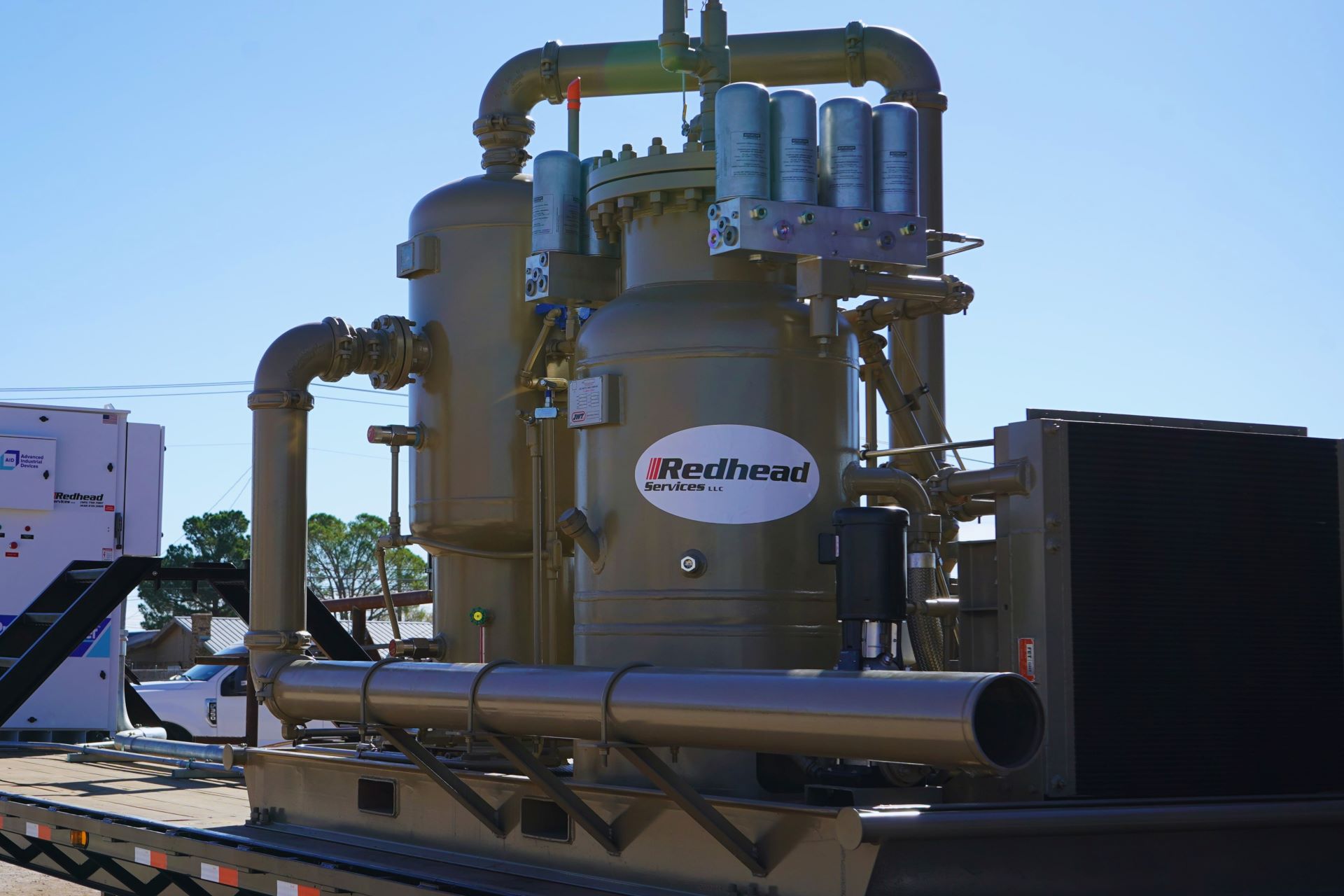
A tank battery is a group of connected tanks that receives and stores crude oil production from one or more wells. In everyday oilfield conversation, the term often also describes the surrounding production equipment that separates fluids, handles produced water, measures production, and manages gas and tank vapors.
If you have driven past a production site in West Texas or Southeast New Mexico, you have probably seen the storage tanks first. Those tanks are only one part of the operation. Understanding the equipment around them helps explain how a wellstream becomes separate oil, water, and gas streams that can be stored, transported, treated, or sold.
What Does a Tank Battery Do?
A producing oil well does not normally deliver a stream of finished, sale-ready oil. Its output can include natural gas, produced water, and solids along with liquid hydrocarbons. The surface facility provides a controlled path for handling those materials.
The SLB Energy Glossary defines a tank battery around its connected crude-oil storage tanks. The wider facility may serve a single well, several wells on one pad, or production gathered from a larger area. Its exact layout depends on the fluid characteristics, production rates, available takeaway, and operating requirements.
The main jobs are to separate the incoming fluids, hold the liquid streams, measure production, and route gas to an appropriate destination. The equipment has to work together across changing well conditions.
How Production Moves Through a Typical Tank Battery
A simplified production path looks like this: well flowlines bring fluids into separation equipment; separated oil moves through any required treatment and into storage or an oil transfer system; produced water moves into its own handling system; and gas follows a separate route toward gathering, compression, treatment, or an authorized control system.
This is a description of the process, not a piping design. Some facilities combine functions in one vessel, use several separation stages, or transfer oil with little storage. Not every tank battery has every piece of equipment discussed below.
1. Flowlines and Inlet Equipment
Flowlines connect the wells to the production facility. Where several wells share equipment, inlet piping and manifolds organize the incoming streams and can support production testing or routing arrangements.
The important distinction is that the incoming fluid is still a mixed wellstream. Its pressure, temperature, gas content, and liquid rate influence what the downstream equipment must handle. A change at one well can therefore affect the workload at a shared facility.
2. Separators
A separator is a vessel that divides the incoming production stream into different phases. A two-phase separator separates gas from liquid. A three-phase separator is arranged to separate gas, oil, and water.
Separation gives the gas and liquids different paths through the facility. Gas leaves through its designated outlet, while controlled liquid outlets send oil and water onward. Separation performance matters because unwanted liquid in a gas stream, or excess water in an oil stream, creates work for the next part of the process.
3. Oil Treatment Equipment
Some oil-water mixtures need more treatment than gravity separation alone can provide. Depending on the production, the facility may use a heater treater or other equipment to help break an emulsion and prepare the oil for transfer.
As the SLB definition of a treater explains, treatment can involve heat, gravity, chemicals, or electrical methods. This is a different job from storing oil: treatment improves the condition of the stream before it reaches the next stage.
4. Crude Oil Storage Tanks
Storage tanks provide holding capacity between production and oil removal. They allow the facility to receive oil while transfers occur on a different schedule, subject to the site's operating limits.
Tank capacity is only part of the picture. Operators also need to understand liquid levels, available working space, connections, containment, and vapor handling. Storage tanks and pressure-rated separators serve different duties; a low-pressure tank cannot simply be treated as another pressure vessel.
5. Produced Water Handling
The water separated from production needs its own destination. A tank battery may include produced-water tanks, pumps, and connections to a water gathering, treatment, reuse, or disposal system.
Keeping the oil and water paths organized helps operators understand the whole facility. Oil storage may have adequate room while a water-handling constraint limits operation elsewhere. Both streams need to be considered when evaluating facility capacity.
6. Gas Gathering and Compression
Gas separated from the wellstream may be routed toward a gathering system for further treatment and processing. Available gas pressure and the receiving system's requirements help determine whether compression is needed.
Wellhead compressors can support gas movement where the application requires a pressure increase. Compressor selection must account for the actual gas stream and operating conditions. A compressor does not remove every downstream constraint, such as unavailable pipeline capacity or a processing outage.
7. Tank Vapor Recovery and Emissions Control
Gas handling does not stop at the separator. Oil entering a lower-pressure tank can release additional gas, and tank filling and temperature changes can also move vapors out of the vapor space.
A vapor recovery unit can collect suitable low-pressure vapors and compress them for an appropriate outlet. EPA's overview of vapor recovery units describes routing recovered gas to a sales line, compressor suction, or an onsite fuel system.
Some facilities also use combustors or flare systems for particular gas-control duties. Recovery and combustion have different purposes: recovery preserves gas for use, while combustion consumes it. The correct arrangement depends on the source, equipment limits, available outlet, and applicable requirements.
8. Measurement, Controls, and Supporting Equipment
A facility also needs a way to understand what it is producing and how its equipment is operating. Measurement systems, including appropriately specified gas meter runs, support production accounting and gas transfer.
Level instruments, pressure instruments, alarms, control valves, and shutdown functions help coordinate the process. Where pneumatic equipment uses compressed air, an instrument air system supplies a supporting utility. These components may attract less attention than the tanks, but they connect the facility's individual functions.
Why the Equipment Has to Be Considered Together
Imagine several wells feeding a shared facility. Their oil and water reach separation equipment, then follow their respective storage and transfer paths. Separator gas moves toward gathering, while tank vapors enter their own collection system.
If gas takeaway becomes restricted, the effect may reach back toward compression and separation. If liquid removal falls behind production, storage availability changes. If a vapor collection system develops a restriction, the tank vapor-handling duty changes. Evaluating one component without its connected equipment can miss the underlying constraint.
Understanding Your Tank Battery Starts with the Process
A useful facility review starts with four questions: what is arriving from the wells, where each separated stream goes, what limits each route, and how changes are detected. That process view makes it easier to discuss equipment needs with suppliers and service teams.
Redhead Services supplies production, measurement, and emissions-control equipment for operations across West Texas and Southeast New Mexico. To discuss vapor recovery, compression, meter runs, instrument air, or combustion equipment for your facility, contact the Redhead team.